I just wanted to follow up on something I got completely wrong on my last post about Sword of the Stars: The Pit.
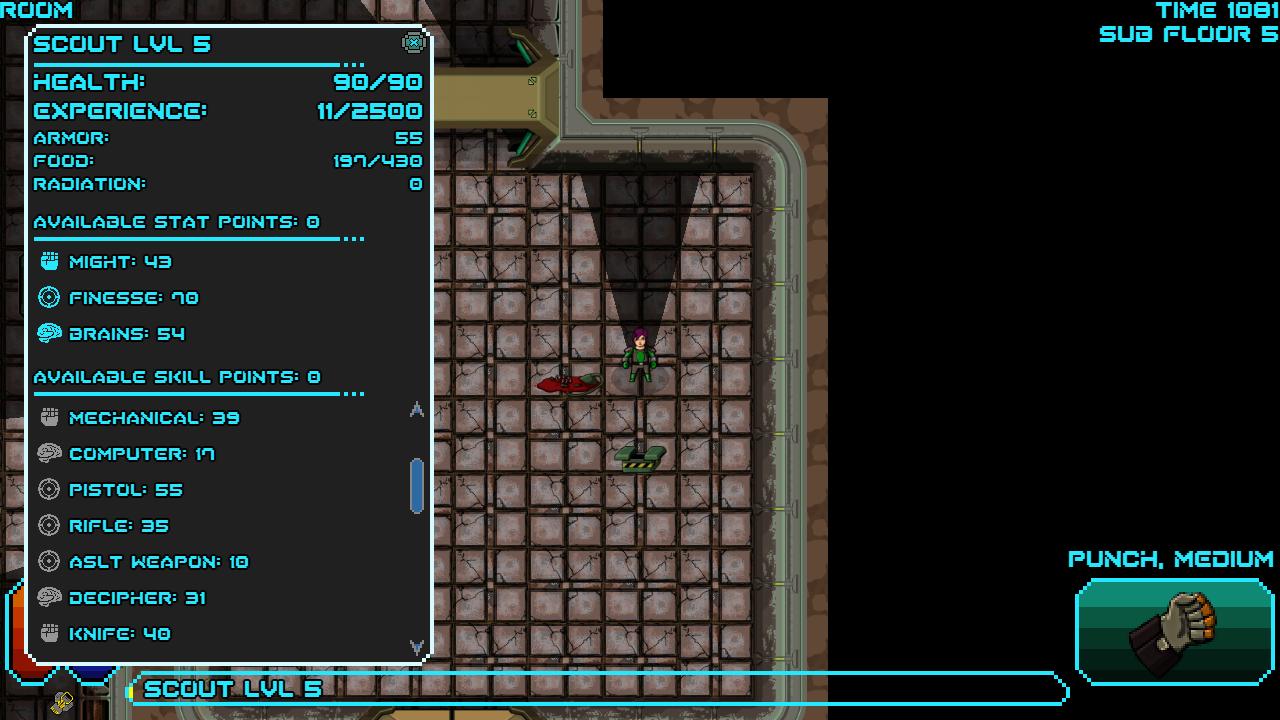
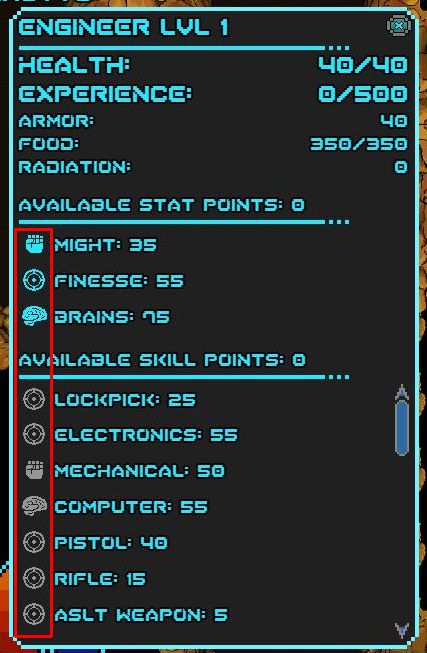
I griped about not knowing what statistic impacts which skills. I was looking for some kind of textual pop-up menu or something to explain this to me, but developer Kerberos Productions reached out to me on Twitter to point out I wasn’t seeing what was right in front of my face. Stats and skills each have an icon that indicates how they’re connected. I’ve highlighted the column of icons in this screenshot.
Turns out I was way off! Next time I dive into The Pit I’ll be better prepared!
When a game contains “Sword of the Stars” in the title, the first thing you think of is space, right? Ships and planets and mining and tech upgrades…SotS is an established space-based 4X IP.
So the first thing I have to tell you about Sword of the Stars: The Pit is to forget all about that. The Pit is actually a sci-fi based roguelike. It is set in the SotS universe, but don’t worry if you’ve never played those games (disclaimer: I haven’t… crazy right?); that’s all just for flavor. The story, if you must know, is that a plague is turning the entire population of a planet into ghouls and the only hope for a cure lies at the bottom of a fabled pit in the Feldspar Mountains where the Suul’ka (I guess if you’re a SotS player you know who the Suul’ka are) once had a base.
So off you go, you brave Scout or Marine or Engineer you, to delve deep in an attempt to find the cure.
This is an old school rogue game. Turn-based combat, random effects on consumables, permadeath (actually I haven’t died yet but I’m assuming it has permadeath) and a constant tension between your two primary resources: health and food. Health slowly regenerates over time, but as it does, hunger grows, and food is scare in the pit.
If you don’t like Roguelikes, stop here. There’s nothing about The Pit that is going to change your mind. If you do like them, read on.
The Pit has a ton of stuff in it. You’re constantly scrounging resources and finding machines that you can use to craft those resources into something usable, in theory. Your first problem (besides all the beasties and bots that want to end you) is that many of these machines are damaged. Luckily you have a chance to repair them. I’ve been playing a Scout and she’s not great at repairing these things and more often than not they go from “Damaged” to “Ruined” when she tries. I suspect the Engineer is better at this, and I fear the Marine is probably damned near hopeless.
Which brings me immediately to my biggest gripe with The Pit. Your stats are never explained. You can guess that Strength influences melee attacks. Brains probably helps with all the crafting skills, which leaves Finesse to control how accurate you are. But I’m just guessing and I’d like to know for sure. Update: I got this bit completely wrong. See this post for details but the short version is that stats and skills all have icons to indicate how they are inter-connected.
Same with Skills. Does the Melee skill only influence bare-fisted punching, or does it also enhance the Knife and Blade skills. Speaking of which, what’s the different between “Knife” and “Blade” anyway? I was ‘born’ with a Knife..maybe there are swords in the game only I haven’t found one yet?
Not a deal breaker but it’d be nice to know this stuff.
I like a good Roguelike and so far I’m liking The Pit an awful lot. I’ve only gotten down to level 7 (of 30) and my Scout is level 6, and I’m playing on Normal level (2nd of 4 in increasing order of difficulty). The first couple of levels were a little easy but I still had my moments.
There’s nothing quite like the heartache of having your weapons and armor damaged badly, finding a broken repair station and, in attempting to bring it online, ruining it completely. After that happened I took to using my fists on a lot of the easier enemies since I’ve only got this one knife and if it breaks I’m screwed. I do have a couple of pistols of course, and so far ammo isn’t a huge concern, but as a roguelike player, your instinct is to hoard things.
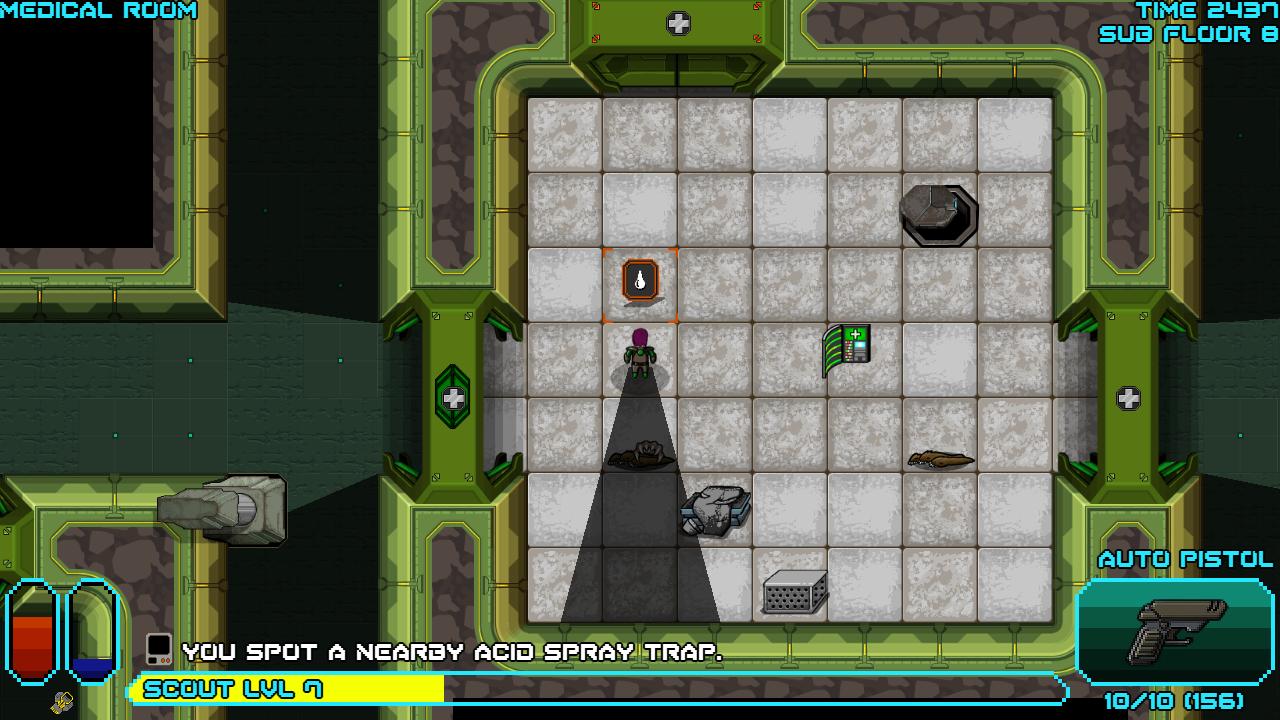
Like grenades. I was hoarding every frag grenade I found. Then I stepped on a trap that destroyed my entire supply of frag grenades? Fiendish! What kind of evil mind came up with that? Stranger still, some traps have beneficial effects, like speed boosts or even heals.
For the more ‘serious’ roguelike players, there might actually be too much stuff going on. You have to collect or discover recipes to craft with (I’m guessing those are the same from game to game) and in addition to the potions with random effects that most roguelikes have (here called serums) there are bio mods for both weapons and armor that likewise have random effects. In my game so far I’ve consumed a purple serum that knocked my Brain stat down two points permanently, a black armor bio mod that bumped up the armor rating of a piece of gear by 10%, and a black weapon bio mode that improved the weapon’s durability by 20%.
A few aspects do set The Pit apart from the other roguelikes I’ve played. First, when you level (at least on Normal difficulty) your health returns to 100%. That makes things a lot easier. Every time you level you also get points to use to increase your main attributes (Strength, Precision, Brains) and your many skills.
Second, the game incorporates a field of view mechanic. Monsters can sneak up on you if they approach from your blind spot (which is fairly small). The tried old roguelike mechanic of running away gets more tense when you can’t see if the monster is still chasing you, and if it’s gaining on you!
If I’ve piqued your interest, there’s a six level demo that you can try out, or if you want to jump right in, the game is only $8.99 on GamersGate. That’s an introductory price that’s good for a week. After that it’ll be $9.99.
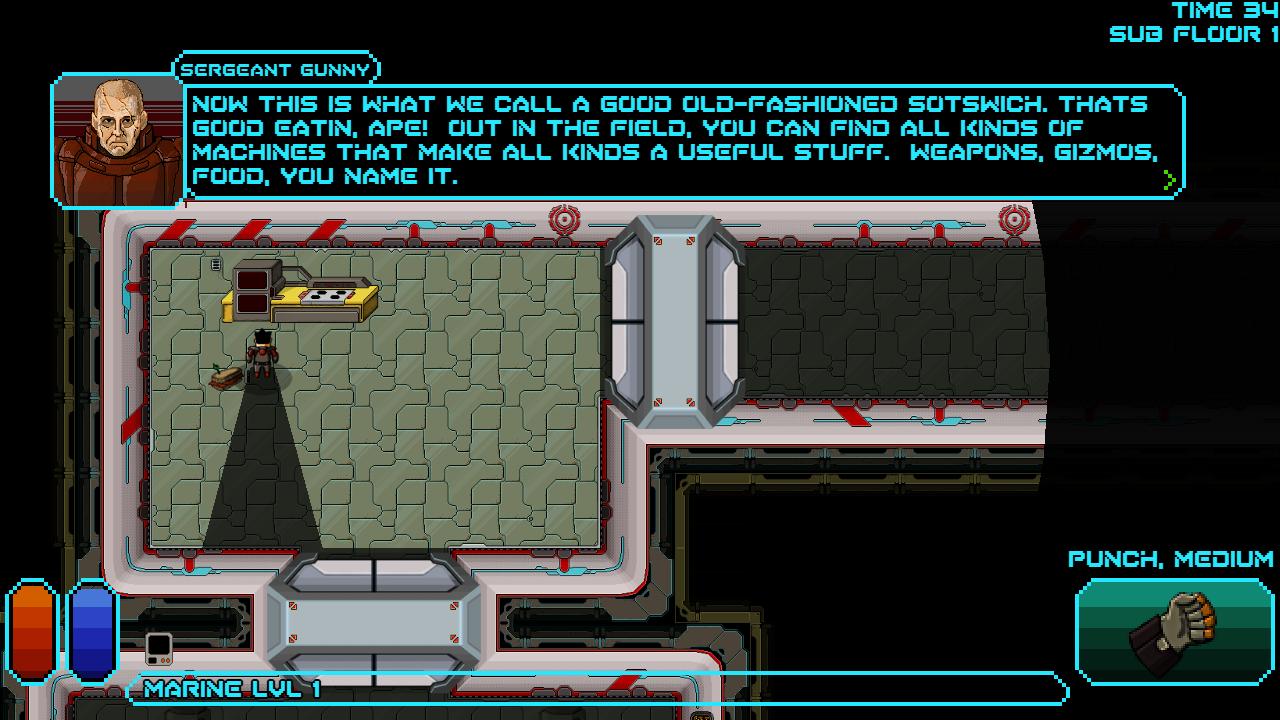
Oh, and there’s a tutorial that’ll teach you how to play. It features an annoyingly abrasive ‘drill sargent’ and mostly you won’t need it to learn how to play, but it does give you a glimpse of what you can expect as you venture deeper into The Pit. The first couple levels are pretty basic.
A few tips:
C brings up the stat page
Escape aborts rest mode
Hey, I tried making a video… this is the first time I’ve every tried to narrate a game I’m playing and I had both technical and performance problems (turns out I don’t multi-task well) but dammit, I made it, I’m gonna post it!
I was really looking forward to the release of Fire Emblem: Awakening and so far I haven’t been the least bit disappointed. I’m loving it!
This time out Fire Emblem has two modes: Classic and Casual. In Classic mode, any unit that is killed in battle is gone for good (unless it’s one of the main two characters in which case it’s Game Over). In Casual mode, they’re just out for the battle and bounce back up after you win. I first started playing in Classic mode but got to a point where I couldn’t get through a fight without losing a ‘major’ character. I thought I’d spread my experience around too thin and that I didn’t have a powerful enough party to get through the next fight, so I decided to start over.
And in so doing, I decided to go with Casual Mode. I knew if I picked Classic mode and got in the same jam and had to start over a third time, I probably wouldn’t. So I restarted, got to the same point as in my Classic game and beat the battle I was stuck on, even though my characters were about the same level.
So then I went back to my Classic game, tried one more time, and got through the battle without losing anyone. So now I have 2 games running concurrently, which makes me feel a bit more brave about my Classic game. I decided I’m going to move forward with it and if a character dies, he or she dies. No more bailing out on a game because a soldier has fallen.
But I can’t just let them die without commemorating them in some way…but that’s what my blog is for!
He shouldn’t have been with us. Chrom had ordered him to stay back at Headquarters to guard it, but young Ricken had other plans. When we accompanied the Exalt to confront the King of Plegia, Ricken secretly followed us, and it was a good thing he did. It was Ricken who rescued Mirabelle, though in truth we nearly lost them both, cut off as they were. But our forces prevailed, the Plegians routed, and we headed home.
Had we only stayed true to our path.
Instead we wandered the countryside a bit, visiting shops in an attempt to restock our gear. It was while doing this that we came upon a Merchant Caravan being attacked by Barbarians. We rushed in to help. It was a chaotic battle, with some of our troops headed to the entrance of a nearby village to help a lone defender and others picking off straggler Barbarians in preparation for confronting their boss. In all the confusion, Ricken paused for a rest within range of several enemy archers. They skirted past our armored defenders and peppered him with arrows. Tragically, Ricken fell. The archers paid the ultimate price but alas, that won’t bring Ricken back. His youthful enthusiasm will be missed.
At least the village, and the mysterious woman who was defending it, were both saved. Ricken would be pleased to know that much, at least.
Your sacrifice will be remembered, Ricken! You were the first of us to fall but I fear you will not be the last. We have a long and bloody war ahead of us.
I’m still messing around with LeapDay and learning a little more all the time. The goal, as developer Danc pointed out in the comments to my last post, is to save the land from evil ghosts. In order to do that you have to (as step 1 anyway) defrost towers and then deliver a specific item to them. I’ve gotten a tower defrosted and found it needed Polished Gems, made with 1 water, 1 stone, and 1 wildcard (anything as the 3rd component).
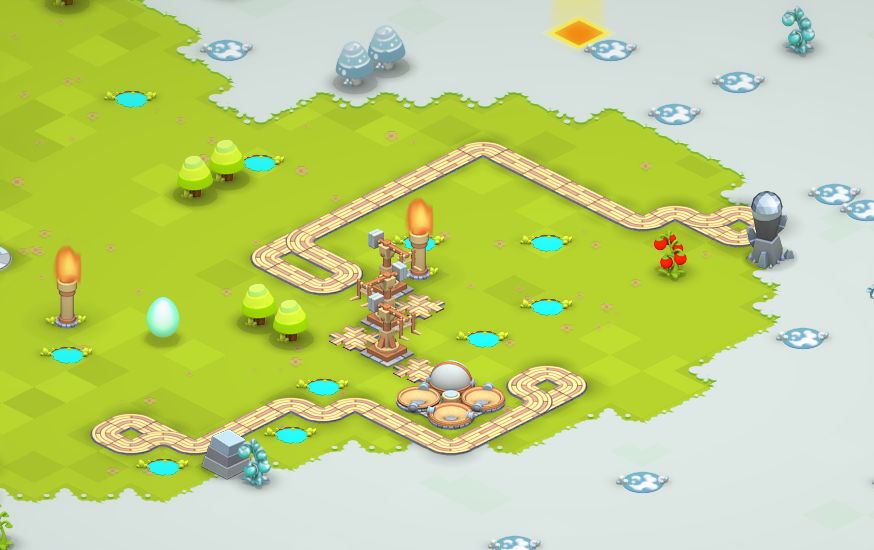
I set up a track and a factory to build polished gems easily enough but actually getting the gems to the tower is going to be a bigger challenge. The Flans that travel the roads will pick up any resource they walk past. So I can’t run this deliver road past anything but the factory pick-up spot and the tower where I’m delivering the gems. Otherwise the Flan will pick up some other resource and just circle around with it endlessly (the tower will only accept Polished Gems). I solved this issue with an elaborate series of 3 cranes, as shown here (you might want to click to get the full sized version):
The problem now is I need 5 houses (at least) to spawn Flans. 1 for the Polished Gem making track, one for the delivery track, and one each for all 3 of those little 1 square sections of road (these will span a Flan who just sits in one place accepting a Polished Gem from one crane and passing it along to the next crane, I hope.
Sadly I don’t have the $$ to do that yet so I have to put my project on hold until later tonight. I still have really big questions around whether or not I’ll get a Polished Gem to that tower before the day runs out. I might have to add additional Flans to the builder track and/or upgrade from the cheap dirt roads to faster stone ones.
What a compelling game… you really need to try it. But be prepared to do a lot of thinking and trial and error when you do. For instance you might wonder why I don’t move the factory closer to the Tower. If I did that I’d pass more water resources and would be in danger of getting 3 water in my factory which would then produce (I think) a barrel of water, which the delivery system would hand off to the delivery Flan and the tower wouldn’t accept, thus gumming up the whole works.
Things I learned:
After your first game (which takes 4 days of real time) you’ll unlock trains and train tracks.
This is 100% a co-operative game. You and the other 7 people on your map all win or you all lose. There’s no ‘score’ to compare yourself to other players so there’s no incentive to trying to ‘beat out’ the other guy. Quite the contrary.
Let’s get one thing clear. I don’t know squat about LeapDay, a game from SpryFox that entered beta this week. I spent maybe 45 minutes figuring it out before I knew I had to share it with my friends.
LeapDay is a browser-based game that tasks you with gathering resources by way of laying down little tracks that your vaguely Gumdrop-shaped workers will follow. As a worker passes a resource he grabs a chunk of it. When he finds a place to put it, he drops it. That place could be your HQ (in which case you’ll get some gold) or a factory. When a factory fills up with resources it generates another, presumably more valuable resource. At that point you need a worker to come past the factory and pick up this more valuable resource to deliver somewhere.
That’s the basic gameplay. I’m not clear what the ultimate goal is… I know I was playing on a map with 7 other people and we had 3 days to beat a boss or unlock a final item or something. I was fixated on the basics, frankly. So before I go any farther, here’s LeadDay in action. Remember I’m still a noob and only have a few tools and a small amount to space to work in:
Every day your workers leave their little houses and start following their tracks and doing their thing. When night comes along they despawn, and resources all renew. Soon enough it’s morning and things start again. As items make it to HQ your town generates gold that you can spend on creating new loops to collect more resources. Your town will collect $$ even when you’re not playing, so there’s a bit of ‘time management’ gameplay here too. Eventually you’ll be able to buy towers that expand your usable area (I have one right next to the crane). I’m not sure what happens when you connect your playable area with another players; perhaps your tracks can mingle.
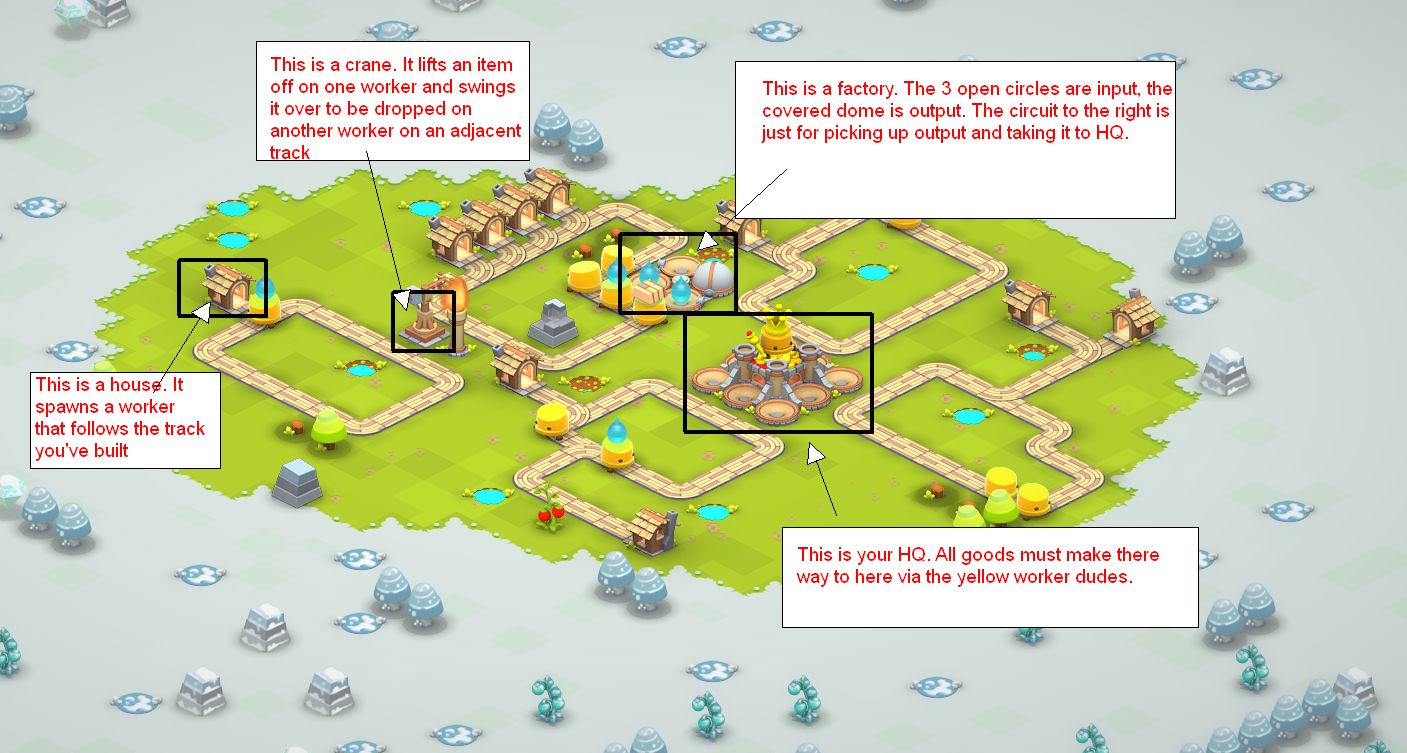
Here’s a crappy screenshot identifying a few parts of my ‘town.’ Sorry I didn’t do a better job with this… I wasn’t planning on using it for a blog post when I created it. Click through for the full size version:
For as cute as it is, I’m finding LeapDay pretty hard. Your workers only turn to the right and available space is cramped. If a track is too long the worker won’t make many circuits before the day ends. If it’s too short the worker might clear out all resources and just be running in circles doing nothing. The nice thing is you can sell parts back for full value so trial-and-error is definitely encouraged (though I do wish you could just move an item rather than selling it and re-purchasing it to place it in a new spot).
In that screenshot my main loop up top drops 4 workers (1 per house) into the track that feeds the factory. You can see all 4 going past the factor as I snapped the shot. The first two have dropped water in the first 2 factory slots. In a second the 3rd worker will also drop water into the last slot and the factory will generate an item. That lone worker on the loop to the right will come around and pick up that finished item and carry it to the HQ. Over on the left is a loop where a worker is feeding the main loop via a crane. Eventually the 4 workers will exhaust their resources and they’ll need more. The crane helps feed them. Towards the bottom right are 2 tracks that are just gathering basic resources and taking them to the HQ. Nothing fancy there.
As you can see my space is pretty cramped and it’s going to be hard for me to get more tracks to run next to the HQ in order to feed items into it.
Anyway, it’s a nifty game. It runs in a browser (you’ll need the Unity plugin) and is free to play. It won’t be for everyone, but it’s unlike anything I’ve played in recent memory and is definitely worth checking out, IMO.
The Level-5/Studio Ghibli collaboration Ni No Kuni: Wrath of the White Witch, has been out for a week as of today. It’s been my main gaming focus since it arrived last Tuesday evening and I thought it was time to share some thoughts. I’ll try to avoid any major spoilers but you may be able to work out when certain game systems unlock. I’ll try to stay as vague as possible. As of last night my main character was around level 20 and I’m somewhere in the 15-20 hour range.
When I first booted up Ni No Kuni my jaw dropped. It is a gorgeous game with a killer soundtrack. Early on in the game you get lots of FMV cut-scenes animated by Studio Ghibli and it feels like you’re playing an anime. I’m using the English voice talent and they’ve been pretty good so far. Little Oliver (the main character) shouts “NEATO!” a bit too often for my tastes but that’s really nit-picking. For the first evening I played Angela was happy to sit next to me and just watch the game. It’s one of those kinds of experiences.
Sadly that richness doesn’t last and pretty soon you’re in a typical (though still beautiful) JRPG, running from battle to battle to level everyone up. The FMV stuff takes a back seat to button-press driven text conversations. That’s not necessarily a bad thing: this is a game, not a movie after all. But personally I could use a bit more animation.
Ni No Kuni is filled with lore, much of it delivered via an in-game manual called The Wizard’s Companion. In addition to practical information about the game world it has a ton of ‘flavor’ info including some fables from this land. I’ve really enjoyed browsing through the Companion and I even took the time to decipher some of the runes sprinkled through it (yes, the Ni No Kuni designers went so far as to develop an alphabet for this world). For gameplay questions you can turn to The Answering Stone which helps you out with questions you have about the actual game mechanics. So much more fun than just a plain help menu.
The main focus of Ni No Kuni is collecting and developing Familiars. The main character, Oliver (you can re-name him if you like) is a young boy who (so far at least) always uses a wand. In practice most of the time you’ll be controlling one of the many Familiars that he can take into battle. These creatures cover all kinds of play styles; your first one is a sword and board fighter for instance. Others lean towards magic using, either offensive, support, or healing. Human characters like Oliver (and the friends he eventually makes) can ‘equip’ up to 3 Familiars each. A few more can be carried in inventory and swapped out between battles. Finally there’s a Familiar Shelter that can hold up to 400 (!) of the creatures.
A Familiar can be customized/progressed in several ways. First they level up and gain new abilities. At certain times they can metamorph into a new form by using an item. From Form 1 to Form 2 is a fixed change, but from Form 2 you can choose from two versions of Form 3 (I haven’t gotten this far yet). When a Familiar changes forms he returns to level 1 and has to be re-leveled but he is potentially more powerful. You can also feed a familiar Treats to improved specific stats. Ice Cream might increase magic defense while chocolate increases physical offense, for example. There seems to be a limit of +10 points in this stat buffing system. [Update: Thanks to Wiqd for pointing out that this limit is tied to a Familiar’s Familiarity rating with you… it can go higher once you’re better frineds with them.] And finally, Familiars can be given gear to improve their abilities. Some use Swords, others use Fangs or Claws. Some use Shield and some used Cloaks…and so on.
In practice what this all boils down to is lots and lots of leveling. I generally have 2 Familiars equipped to fight with and one per/character that is along for the ride getting free experience and it isn’t unusual for someone or something to be leveling up after every battle. In general I like leveling characters, thank goodness.
The problem, for me, is that I’m not finding the combat all that satisfying and as is typical in an JRPG there’s a LOT of combat. During a fight you can control one entity. That can be Oliver or one of his friends, or it can be a Familiar. Only 1 Familiar per character can be on the battlefield at a time, and the human characters share their health and mana pools with their Familiars. I’m finding that the mana pools are pretty small which means I’m doing a lot of melee combat and mostly just clicking Attack over and over for random battles.
Boss Fights are much more interesting. They go on for long enough that you’ll have to swap out Familiars (they get tired as a battle rages on) or pop onto your Human characters to use items. However I find the whole process of changing characters to be kind of awkward and in general the battle system feels more frantic than I’d like. I don’t mind action-combat and I don’t mind turn-based combat but Ni No Kuni feels like “frantic menu selection” combat that just leaves me feeling kind of frazzled.
Once you have a 2nd human character in your party you can assign tactics to the AI. These are fairly ‘coarse’ assignments and the AI isn’t at all smart about conserving resources. So if you tell a friend “Keep us Healed” that friend will spam heals and be out of mana in no time. I really miss being able to say, y’know, “If my health drops below 50% heal me.” You can change tactics in the middle of a battle but it takes a long time to do and means you’ll miss at least one attack in doing so.
So yeah, this isn’t my favorite combat system ever. I don’t hate it, but it’s not my favorite. And there’s a lot of combat. So that’s wearing on me a little, but I think there’s more that’s bothering me about Ni No Kuni.
Part of it is Oliver. When I play an RPG in some sense I’m always trying to RP the main character. But Oliver is a 10 year old boy and there’s not a lot in him for me to relate to. So I remain an observer to the action. Also the Familiars are all very cute. If you find a bad-ass sword and give it to your familiar…he’ll still look very cute. His appearance doesn’t seem to change except when he advances in form. These aren’t faults with the game; they’re just aspects that don’t sit well with me, personally. I really like for a game to visually reflect my character’s advancing levels/bad-assitude.
The other issue I have is with pacing. After a brisk start the story just bogs down pretty quickly. There are a lot of side-quests you’ll want to do in order to level up your Familiars (and earn some perks for Oliver) but none of them are very compelling. There’s this heart system where you have to borrow some ’emotion’ from one character and give it to another (this guy needs courage, that gal has a ton of courage, let’s borrow some from her) which seems really cool at first but then you realize these are just FedEx quests really. The characters who have ‘heart’ to spare are indicated on the map so you just run and find the one who has the aspect you need, click through a conversation to get some goodness, and go dump it on the quest-giver. Other sidequests are of the Kill Ten Rats variety, or collect 5 pelts. You know the drill.
So that’s where I stand. After my first night of playing Ni No Kuni I probably would’ve called it a 9 or 10 out of 10 game, but after a week of playing I’m thinking it’s more of a 7 or so. It’s still a solid, lengthy JRPG with lots of leveling and sub-systems like Crafting (via Alchemy) and tweaking Familiars via treats. But while the game is beautiful to look at, there’s nothing really revolutionary here and the story is dribbled out to us at such a slow pace that it kind of loses impact.
I think part of my problem is I’m focusing on it too heavily. I think I need to mix in some other games while playing Ni No Kuni. That’s how I’ve been playing Harvest Moon and it’s helping me to really enjoy that game. Fire Emblem comes out next Tuesday and that might be just the ticket to breaking up the grindy parts of Ni No Kuni.
I’m surprised that Ni No Kuni: The Wrath of the White Witch has been getting such awesome reviews, to be honest. I’m wondering if I’m the only one feeling slightly disappointed in it. I mean I really WANT to love it, and for a few days I was lying to myself about loving it, but the truth is that while I do absolutely like it, that’s as far as we go. Me & Ni No Kuni are just good friends. I have no regrets about buying the game but (unless things change in the latter parts of the game) it’s not going to end up in my list of all-time favorite games or my personal ‘game of the year’ awards or anything like that.
[Update: I just found out Defiance, which I reference as a free-to-play title in this post, is going to have a shelf price of $60. So scratch that one from the list.]
A recent experience has me wondering what the long-term impact of so many free-to-play games will have on the industry. Now to be fair I’m doing that thing where I assume my experience reflects that of most gamers, so keep that in mind while you read this post.
I’m a casual shooter fan. I don’t play many shooters; the last one I picked up was Halo 4 I guess. I don’t play them competitively. But every so often I get in the mood where I want to run around shooting stuff and seeing things explode. In Ye Olden Tymes that would’be meant heading to the game store and seeing what’s available.
Not any more.
Friday night I was in the Defiance stress test. There’s an NDA on that game but it’s no secret that it’s an MMO shooter. The stress test was only a few hours and when it finished I found myself still in the mood to shoot stuff. So on Saturday I patched up Firefall and I spent Saturday and Sunday having fun in that beta. Firefall is also an MMO shooter. It has PVP but I was doing PVE and co-op PVE activities in it while I played.
Monday came around and I decided to change things up and play Borderlands 2. I think it’s safe to call BL2 a good game. I’ve seen it on some ‘game of the year’ ballets and most people seem to like it. I like it too. But it costs $50-$60 (or did when it launched anyway).
If I had it all to do over again, I probably wouldn’t buy Borderlands 2 at that price. Now I have to tread gingerly here. BL2 is priced competitively in the traditional gaming space. Compared to Halo 4 or Call of Duty its pricing is perfect. I’m not trying to knock BL2 in any way.
But for a casual shooter fan like me, I can really get just as much fun out of free games like Firefall, Planetside 2, Defiance or maybe even Dust 514 as I can out of BL2.
For people who take their shooters seriously I’m sure this isn’t the case, but I wonder if there are enough serious shooter fans to support many big budget $60 games. It is my understanding (and I may be wrong) that game publishers need casual gamers to purchase their titles in order to thrive.
So in the future, how will these publishers lure in casuals like me? What are they going to offer me that I can’t get for free?
For Christmas I got myself a 3DS XL and the first game I bought for it was Harvest Moon: A New Beginning. I’ve been playing it off and on since Christmas and figured it was time to talk a bit about it and about the 3DS itself.
Generally speaking I’m pleased with my new gaming hardware. The 3DS XL is “fun” in a way that few game consoles are. I mean even without loading a game into it there’s stuff to do, like put your Street Pass friends to work clearing a dungeon. Luckily I got Angela her own 3DS XL so we can be each other’s Street Pass friend. You can put the thing in your pocket and take a walk and earn “Coins” that you can use in the same game. You can send goofy notes to your friends. It’s a nice system. That said, the 3D aspect feels like a gimmick and neither of the screens can hold a candle to the one on the Playstation Vita.
My only real gripe with the 3DS so far is that even in it’s XL format it feels a little small when it comes to the controls. My right thumb, in particular, cramps up a lot from hitting the face buttons; it’s not a system I could spend hours using. But since it’s a handheld I probably wouldn’t anyway.
Now, on to Harvest Moon. If you’ve ever played a Harvest Moon game you’ll feel comfortable here. Same old basic game: you have to re-build a farm, planting and harvesting crops and raising animals. In the meantime you have to befriend villagers and help the town grow and ideally, find yourself a spouse. If you haven’t played a Harvest Moon game this likely seems really boring. It’s a quirky genre, for sure. Kind of a mix of virtual world and survival game (though you can’t actually die as far as I know) and I guess dating simulator.
This particular Harvest Moon changes things up by starting you with an intact though small farm and an almost empty town. You need to liven things up in order to get people to move in. So you have both a farm and a town to rebuild. That’s the good news. The bad news is that for the first 25 or so “days” of gameplay you’ll probably be bored stiff. Most of the other Harvest Moon games I’ve played have made you clear out debris from your fields as a first step while trying not to exhaust yourself. A New Beginning gives you a pristine farm and very few chores to do.
You get up at 7 am (I think?) and head out to tend your crops. You’ll have that done by 9 am or so, after which the only thing to do is walk through the woods collecting bugs, logs, rocks, flowers and herbs that you’ll later need to build things or to use as gifts. This is fun the first few times but then it starts to feel like a chore. Generally for the first few days I was going to bed (and thus ending the game day) by 1:30 in the afternoon.
After a week or so you get a cow and that actually makes things worse since you have to push the cow out of the barn in the morning and push him back in at dusk. Cows are happier when they get to graze outside. It’s nice to have one more thing to do but once you have a cow you can’t go to bed super early because you have to leave the cow outside until near dark (I assume that the longer they are outside the happier they’ll become). There were times when I’d put the 3DS down and read a book while I waited for time to pass!
To make a long story short, the game is pretty dang slow until the 25th day of Spring in your first year. That’s when an architect moves into town and then you can start buying blueprints and building new features, and the game becomes much more enjoyable at that point. But wow, what a slog to get there!
In fact I’ve just gotten there and I’ve been trying to scrounge up the Mint I need to build a Chicken Coop so I can buy a few chickens to raise. Don’t ask me why I need mint to build a chicken coop but it’s nice to have things to do other than tend the handful of crop patches I started out with. I can also now edit the farm to move things around, which means there’s a reason to chop down trees and so forth. And I really want to craft a Bell so I don’t have to push the cows all over the place.
I guess this post isn’t going to sell you on Harvest Moon: A New Beginning but I just wanted to share the fact that the 25th of Spring is the date you have to drive through the boredom towards, in case you happen to be playing and gave up before then. I would’ve given up had I not been warned in many reviews that the game is super slow at the start.
For the past two evenings I’ve been wallowing in strategy game nostalgia with Eador: Genesis. This is an older game, originally published in 2009 by Ukrainian developers Snowbird Studios. An English translated version hit GOG.com last week at a bargain price of $6.00.
If you have fond memories of Master of Magic, Warlords, or Lords of Magic then you are going to love Eador: Genesis. It’s got everything you can ask for: the city building and resource management of a 4X game, the leveling of an RPG and turn-based tactical battles of a classic strategy title.
The premise is that the universe of Eador is busted up into many tiny shards, and your goal is to create order in the universe by conquering each of these shards. Essentially each shard is a level/map/mission in the Campaign, but each one also unlocks certain buildings so there’s kind of a meta-game of deciding which order to conquer them in.
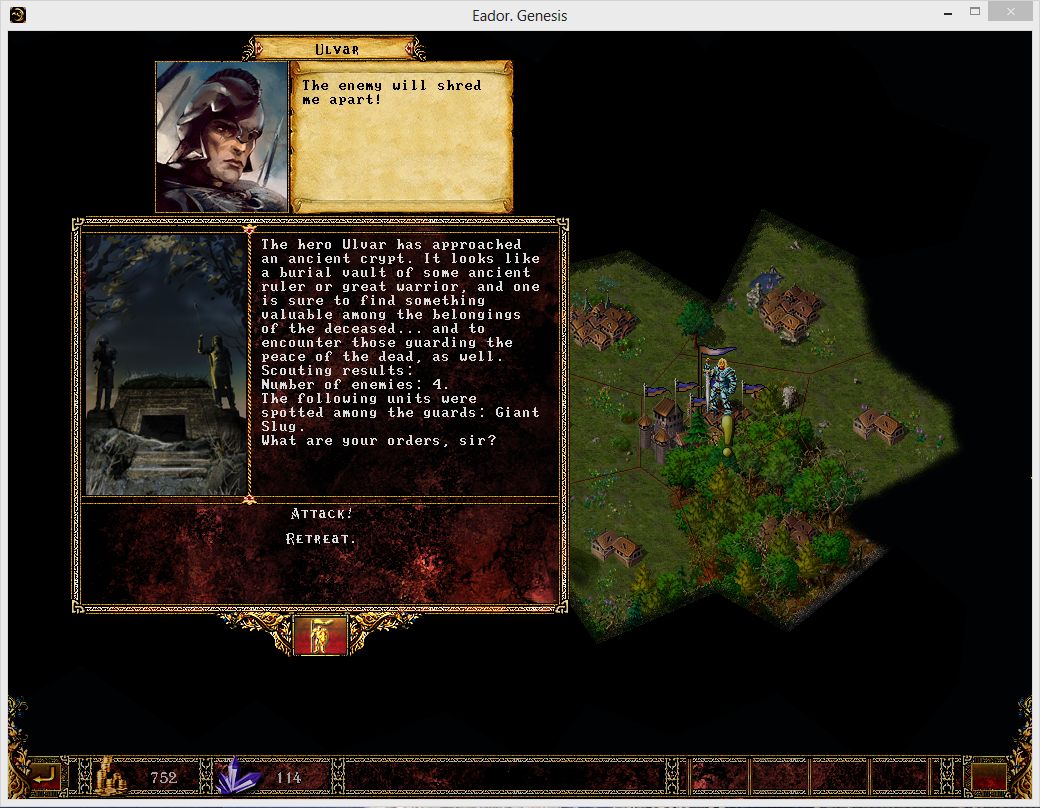
Once you decide on a shard to attack (and your first one is pre-determined) you move to a map of that shard where you get a citadel from which you can hire one or more heroes. Eventually you’ll hire troops to travel with these heroes, buy gear for the heroes, teach them spells and finally send them off to battle. Before you do that, though, you’re going to have to build the shops, temples and training grounds that can produce all these resources (this is where the buildings come in…you need to unlock buildings by conquering shards to get advanced units and gear).
The map is hex based and every hex is occupied, so every time you move you’ll have to either fight or negotiate with the occupiers of that hex. IF you fight and conquer the hex you’re going to have an unhappy populace on your hands. You can buy guards to help keep the peace, or erect buildings that make the local populace happier.
In lieu of moving to an occupied hex you can opt to explore one you already occupy. Doing so will often uncover lairs full of monsters and treasure; good both for filling your coffers and leveling up your heroes and troops.
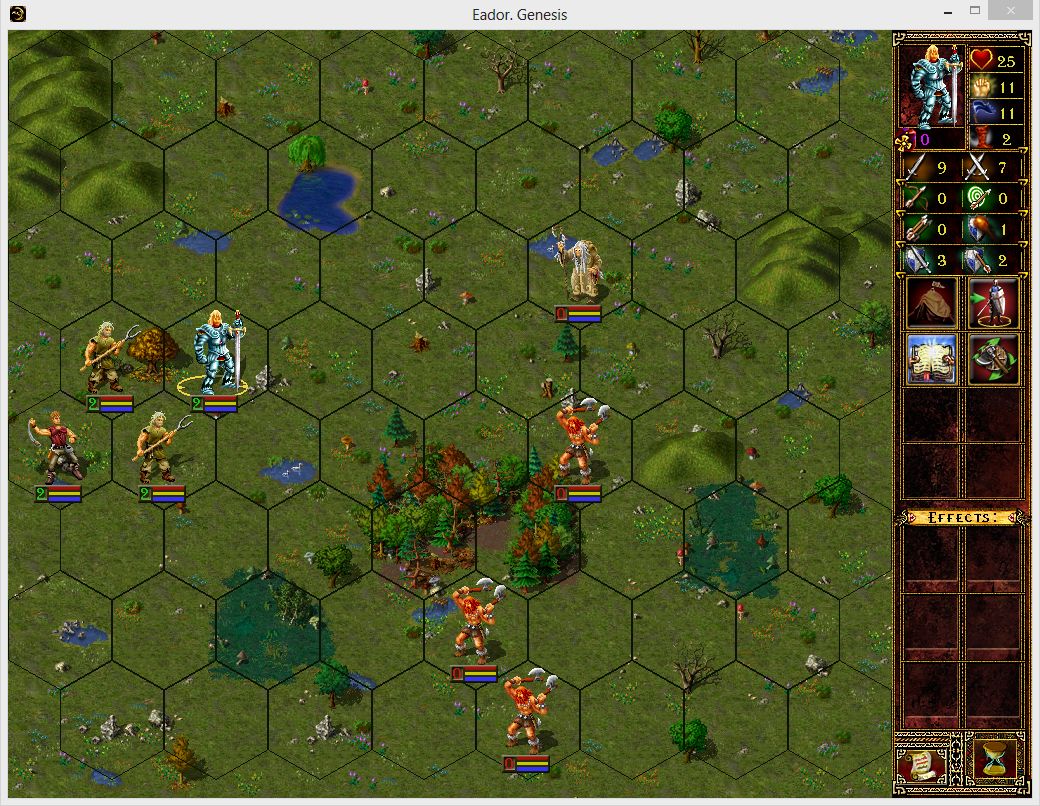
When it comes time to do battle you’ll move to a tactical, hex-based battle map with varied terrain that impacts attack and defense strength as well as movement costs . You place your troops and then participate in a turn-based battle. Generally (for me so far at least) your hero will be much more powerful than your troops and a big challenge can be letting the troops get experience by fighting, but not getting them killed. Dead troops are gone forever; a hero can eventually be resurrected.
After a battle both your troops and your hero may level up. If they do you get to choose from a pair of perks for that unit. Often these are as simple as +1 attack vs +1 defense, but sometimes they’re offered skills as well. Additionally a troop unit that performs exceptionally well will be offered a medal that gives them a stat bonus.
And that’s the basic gist of the game. For every Shard there’s a Big Bad that you have to defeat in order to claim that shard. If you’ve never played this kind of strategy game it can be a bit daunting but if you have, you’ll slide right into Eador like a comfortable old shoe.
But speaking of old, the graphics of the game are quite dated and the game runs at basically 1 resolution (1024×768). You can run it full screen but on most modern monitors it’s going to be terribly stretched out if you do so. [Tip: The GOG installer creates two shortcuts, one to run in Windowed mode and one to run full screen; there are no settings in the Options menu for this.]
It’s also worth noting that this game is difficult, even on the easiest setting. At least I’m finding this to be the case. As I said, I’ve only been playing for two evenings but I lost the battle for my second shard and was thrown back into The Void. I can attack again but my funds are seriously depleted and that’s going to make my next attempt even more challenging. I may need to re-start the campaign; we’ll see. (There is no manual Save feature so I can’t just go back to before I attacked Shard #2 and try a different tactic.)
For $6, I don’t think you can go wrong if you’re a strategy gamer (unless you just can’t deal with the old-school graphics). Eador:Genesis has that “1 more turn” compulsion that can keep you up well past your bedtime.
Eador did well enough for the studio that they’re working on a 3D sequel, Eador; Masters of the Broken World. It’s currently in Steam’s Greenlight section and I hope you’ll give it a thumbs up. Based on what I’ve played of the original game, I’m really excited to see how the modern sequel comes out!
[Disclosure: I was provided with a review copy of Eador: Genesis.]
I finished Book of Unwritten Tales: The Critter Chronicles tonight. It is a well-made adventure game full of jokes and fiendish puzzles and a nice enough story. In short, insofar as I can tell with my limited experience in the genre, it’s a solid adventure game.
And I am SO glad to be done with it.
I started out doing OK. I really enjoyed Chapter 1. Chapter 2 got me a little frustrated but after some time away a few potential solutions occurred to me and I started making progress again. In Chapter 3 I was having fun again and by now enough other people were playing that when I got stuck I could Google my way to a hint. By Chapter 4 I felt like I was doing more Googling than playing, and about half-way through Chapter 4 I ground to a halt. Tonight I found a complete walkthrough and used it to finish the game just so I could feel OK about moving on to something else.
I really want to stress that this wasn’t the game’s fault. Plenty of people are really enjoying Critter Chronicles and if you enjoy adventures you probably will too.
But I just don’t have the stamina for solving one puzzle after another like this. I could feel the frustration slowly building in me. I mentioned that the nice thing about pure point and click adventures is that as a worst case, you can kind of ‘brute force’ your way through a sticky spot by just trying to use everything on everything else.
The more I played Critter Chronicles the more impatient I got with myself and the more I went straight to brute-forcing my way through, and the more I did that the more aggravated I got with little things like the amount of time it takes to switch characters or for the cursor to go from ‘doing something’ to ‘ready for input.’
And by the time I got to that point, I wasn’t even noticing the puzzles I solved so I wasn’t getting that “Aha!” satisfaction from them. I just expected myself to get those and was frustrated with myself for not getting the others. I was in a bad place by the time I found that walk-through, actually angry at the game! (Silly, I know.)
Critter Chronicles isn’t a long game. Steam says I spent 9 hours on it. But I think for me to enjoy adventure games they have to be even shorter than that. I could probably enjoy an episodic game that came out in several parts, each part being 2-3 hours long, and with a few weeks between each part to let my ‘puzzle frustration toxins’ dissipate.
I -could- have just played 1 chapter at a time of Critter Chronicles and then waited a few weeks to go on to the next chapter, but I would’ve been setting myself up for failure that way, too, because the game has a lot of back-references and even in the 6 day time period I spent playing I’d totally forgotten about at least one character who was needed to solve a late game problem. Imagine if I’d tried to go back to the game weeks later?
Anyway, bottom line is, as much as I want to love adventure games, this foray back into the genre has proven to me that I just don’t have the brain/personality/patience to really enjoy them. Better to face this then to be miserable playing a game, right? I still have tons of other genres to love!
One more time though, I want to say if you DO like adventure games, then Critter Chronicles is probably something you’d enjoy! Don’t like my anti-adventure attitude sour you on this title!
 I just wanted to follow up on something I got completely wrong on my last post about Sword of the Stars: The Pit.