Stumbling on Happiness

Stumbling on HappinessI picked up Daniel Gilbert’s Stumbling on Happiness on a whim a while back. I didn’t even look at it carefully. I think I must’ve been depressed that day and saw this as some kind of self-help book. Which it isn’t. Instead, it’s a kind of “How Things Work” manual for your mind, focusing on what and why things make us happy.

Gilbert’s argument (and he backs it up with lots of research; there are many pages of footnotes at the back of the book) is that people make choices according to what they think will make them happy, but that these choices are often at least partially wrong. In other words, they make a prediction as to their future happiness basing the prediction on the assumption that they’ve made a particular choice. The problem is that people are lousy at making these predictions, and Gilbert explains why that is. Picking a random example, he cites a study where college students were asked to predict in advance how happy they’d be if their team won a big upcoming football game. Then after the game, they were asked how happy they were. It turns out that they weren’t nearly as happy as they’d predicted they would be. Why? Because when they made their predictions, they imagined the end of the game, the final play and all the hoopla. But they neglected to imagine that they still had a test to study for, piles of laundry waiting to be done, or financial woes. Their imaginations didn’t paint the whole picture when making the prediction of happiness.

That’s just one of many, many examples. Throughout the book we learn all kinds of things about our minds that we might already know if we ever stopped to think about it. For example, how bad we are at noticing things that aren’t there. A classic example is this card trick that made the rounds of the web a while back. If you haven’t seen it, go on and try it. I’ll wait.
.
.
.
.
.
.
Back? OK, so what’s the trick? I already gave you a clue. The trick is that none of the cards on the first page are also on the second page. But under normal circumstances we don’t notice that. We’re focused on ‘our’ card and ignore the others, so when we get to the reveal page, it (normally) never occurs to us to check the other cards. We see that our card isn’t there and we’re amazed! OK, well, we’re puzzled at least.

Anyway, back to Stumbling…. In spite of all the footnotes and citations, Gilbert has a breezy, conversational style that makes the book easy going for us laymen. He’s pretty funny at times, too. I will admit that after a while the book starts to feel a bit repetitive as he describes study after study that support what he’s telling us. It’s the kind of book that’s best read a chapter or two at a time, interspersed with other reading materials. And the focus here is on why we make the (often wrong) predictions that we make; there’s very little in the way of self-improvement tips.

And yet, I came away feeling as if at least a few scales had fallen from my eyes. Once you’ve been made aware of the way your imagination can paint an inaccurate picture of the future you can (in theory) allow for that. Perhaps more importantly, it’s encouraging to know that we’re not alone. That almost everyone who tilts at the gold ring isn’t nearly as happy to capture it as they thought they’d be. Knowing ourselves better is never a bad thing. Stumbling on Happiness teaches us about ourselves in a fairly entertaining way, and so gets a big thumbs up.

The Prodigal Troll

The Prodigal TrollCharles Coleman Finlay’s The Prodigal Troll is another title out of that box ‘o books that I got from World Fantasy Con. They say you can’t judge a book by its cover but damn, did Pyr ever do a terrible job on this one. I never would’ve picked this up off a bookstore shelf.

Not that it would’ve been a huge loss. This is Finlay’s first novel and though he writes very nicely, the story took an awfully long time to grab me. Ever since Romulus and Remus were suckled by a wolf, tales of humans being raised by beasts have been a part of folklore and this is the trope that Finlay has set out to explore once again. OK, technically the human in this story is raised by trolls and not beasts, but the trolls act like apes who have language and can’t be exposed to sunlight. Our hero Mowgli…I mean, Maggot, grows strong and clever because he has to fight for acceptance among the clan that he is a member of. Had the trolls been apes, the story wouldn’t have had to change much at all.

Once he leaves the world of trolls he falls in with a tribe that takes its culture from a mixture of Native Americans and one of the more primitive tribes of the British Islands. Picts, perhaps? I’m no historian. The names are very olde English but some of the dancing and pipe smoking behaviors feel Native American. In either event, the culture of these people feels recycled. These tribes are pitted against a matriarchal version of a typical pseudo-medieval culture lifted out of fantasy. Actually, this culture has some interesting facets. For instance, eunuchs are treated as women legally, which means they can own property. This leads fairly powerful or well-familied men to become eunuchs.

The sad part is we just get glimpses of this, the most interesting culture in the book. Presumably Finlay is planning Troll to be the first of a series in this world and is laying the bedrock for later tales. In fact, we get glimpses of a lot of interesting ideas. The Knights are driving out the Peasants who are driving out the Trolls. There are ‘demons’ in the river that play a much too minor role in the story, and we meet a wizard or two who are very interesting but don’t get much ‘air time.’

But the greatest insult, and I really felt betrayed by this, is that the first 100 pages or so tell a totally different story with different characters. Characters that I came to like, with their own fears and desires and struggles. In many ways this was my favorite part of the book. Then *poof* they’re gone from the pages, never to be seen or heard from again!! They end up just being the device that Finlay uses to get the human child into the hands of the trolls, but he took much too much time with this and asked us to invest ourselves in these characters…only to toss them aside.

It really soured me on the whole story, and I think changed the way I read it. Almost as if I was looking for things to gripe about after that.

Now all that said, should Mr. Finlay write another novel set in this world, I wouldn’t be opposed to reading it, because by the end of this one he had hooked me. Mostly this was due to his word-craft. I really did enjoy the way he wrote. This is a first novel and I’m sure his next will be even better. Thumbs up or down on this one? I think my suggestion would be to wait and see what else comes out in this world. If Finlay doesn’t revisit it, then The Prodigal Troll will end up feeling like a tease.

Happy New Year

Well, 2006 is behind us now, thank the gods… I can’t think of anyone for whom 2006 was a really good year. I’m sure they’re out there, but among my small circle of friends it was a year of upheaval at best, and just a bad year at worst. Perhaps 2007 will be better for everyone.

I spent New Year’s Eve watching the extended versions of The Two Towers and The Return of the King. A nice, quiet evening (I’d finished watching Fellowship yesterday). Somehow these movies are trying their best to become a holiday tradition with me.

Anyway, here’s wishing everyone who reads this a happy, healthy and prosperous 2007!

A nice Callie card…

Today a card arrived in the mail, from where I’d been taking Callie:

Dear [DC],
We are very sorry for your loss of Callie. We understand that Callie was truly a part of your family, and we know that you must miss her very much.
We hope that it may offer you some comfort to know that a donation has been made, in Callie’s memory, to the hospital stray animal fund. Callie was very lucky to have had you to care for her.
With deepest sympathy,
Dr. [Callie’s doctor] and staff at
Marlboro Animal Hospital

I thought that was an awfully nice gesture, and on the off chance you’re in the Marlborough, Mass, USA area and in need of a vet I’d confidently point you to the Marlboro Animal Hospital.

I sure do miss the little furball. I’ve been re-arranging my house a bit to kind of fracture the memories a little. I still find myself looking for her, and I lose track of the time every afternoon because no one is curling around my ankles reminding me its dinner time.

At the same time, the acute pain of loss is already fading, which is good I suppose. I regret not having taken more pictures of her… I had a lot on my old cellphone but never transferred them off and the phone is long gone now. And I tossed all her toys and kind of wish I’d kept one as a memento…

My friends have been very supportive and that’s helped an awful lot.

Callie (????-2006) Rest in Peace

CallieI lost a friend today, after about ten days of trying one cure after another. My strange little cat, Callie, who came into my life about two and a half years ago, was put to rest at noon today.

I am overwhelmed and startled at how sad I am over this. I’ve lost grandparents and my father and a step-brother and a step-father and I don’t remember ever being quite this sad…and its over a cat. Strange, and probably not really true. I’m sure I’ve just buried the old griefs so that I don’t remember them as being as bad as they were. Or maybe its just that she was so totally dependent on me.

Callie was a wonderful creature, though she wasn’t much of a cat. She was a street cat that wound up in a shelter somehow and I don’t think she spent much time with her mother learning to act cat-like. We think she’d had some kind of head trauma, because she couldn’t walk very well and seemed constantly surprised by the world. She was a total mess of a cat who had trouble eating and so wound up with food in her fur constantly. That said, she’s often decide my beard needed grooming when I picked her up. She was sweet and good natured, but she hissed when she wanted attention (other than a quiet purr, hissing was the only sound I ever heard her make). She seemed happiest with a warm lap to nap on, or failing that, to stretch out alongside a reclining human. When I brought her home she had ear mites so bad that I think she was mostly deaf. She couldn’t see very well, either. Couldn’t walk very well… though she ran fine. And her lack of grooming talents extended to both ends of her, and more than once I had to plop her in the bathroom sink to bathe her. When this happened she’d quietly accept it, but she’d just look at me with this totally puzzled expression.

Today was her 4th trip to the vet in ten days and she wasn’t getting any better. She’d been mostly sleeping for almost a week and we decided that the best thing for her was to end her misery. I knew it was coming so we spent a lot of time together over the past couple of days, her sleeping in my lap while I watched endless tv while petting her and giving her scritches under the chin. At the vet I kept on petting her and keeping her comfortable while she drifted off (they give the animal two shots. The first puts them to sleep and the second actually kills them). I kept on petting her while she got the second shot. The vet checked her heart. It had stopped. He told me to take all the time I needed and left the room. I kept on petting her for a good while longer even though she was beyond feeling it. Then I left her body laying on the examining room table and came home. I chose to have her cremated; I’m not big on burials.

When I got home and saw her toys all over, and her favorite box (she *loved* cardboard boxes, as most cats do) waiting for her, I lost it all over again. I quickly gathered up all her things and removed them. Then I went out again. When I came home the house felt empty and silent, even though she wasn’t a ‘greet you at the door’ type of animal usually. I still opened the door carefully, though, just in case, because she wasn’t really smart enough to get out of the way if she was there.

I have no idea how old she was, but she was only with me for about two and a half years. When I adopted her they told me she was two, but the vet felt she was much older, and I tend to agree. She was pretty much a lap-cat and it took a lot to get her motivated to play. She clearly led a rough life before she came to live with me. I think she was happy to end up with me. I remember the day I saw her picture on PetFinder.com and just knew she was the cat for me. Oddly, I’d wanted a big cat and she was tiny. That laptop she’s sitting on is a 12″ iBook, just for a sense of scale. I went to the shelter and they opened the door of the cage she was in and she just climbed up into my arms like she’d always known me.

I’m really going to miss that little furball…

Swordspoint

SwordspointAfter reading Ellen Kushner’s The Privilege of the Sword I immediately went in search of Swordspoint, the first book she set in The City (thus far she has refused to give the city a name). The volume comes with the novel and 3 bonus short stories set in the same world.

I’m finding it hard to be objective about Swordspoint because, honestly, I was disappointed. But I was so hopelessly smitten by Privilege that perhaps disappointment here was inevitable. It isn’t a bad book but it doesn’t feel as substantive as Kushner’s most recent volume. I wonder if I would’ve felt that way if the world was new to me. I think a lot of the delight in Swordspoint would come from meeting the characters and learning about this strange city where nobles plot their Machiavelian plots but the Kings have been ousted.

In Swordspoint Alec and Richard are young men, lounging about in Riverside, being in love, and getting into trouble. Alec is an unknown quantity (and again, this may have changed the experience for me, as I knew who he really was from page 1) and Richard is an infamous swordsman in much demand from the nobles. Lord Ferris is a power-hungry up-and-comer, yet to experience the setbacks mentioned in Privilege. Duchess Tremontaine is in the prime of her beauty and power. It was nice, in particular, to get to know her.

When Richard refuses a contract from a particular noble, the Lord in question takes it upon himself to try to force Richard’s hand. Richard retaliates and ends up finding himself in hot water (I’m being intentionally vague). Huh, come to think of it, maybe that’s my problem with the book. There’s a ton of ambiance and character description and seeing the city, but really not a lot happens. There’re a few threads that kind of peter out to no apparent purpose. And if I were to be honest, the ending felt…well, almost like Kushner had to stretch to gather in her threads and tie them all off.

It certainly isn’t a bad book. But it isn’t of the same “omigawd you have to read this!!!” caliber that Privilege is. One of the short stories at the end is called The Death of the Duke and was very satisfying. The other two were just good fun. If you love this world that Kushner has created, you’ll want to read Swordspoint just to learn more about events mentioned in Privilege. But don’t expect to be as amazed as you were with the later book. I’d love to hear the opinion of someone who reads this book first; if anyone stumbles on this blog and wants to do a mini review I’d be thrilled to post it.

NYC health board bans trans fats at restaurants

I don’t usually do commentary on news items, but this one really caught my eye. An Associated Press article on CNN ( NYC health board bans trans fats at restaurants) reports that the New York City health board has instituted a ban on the use of trans-fats in restaurants. They have to switch over to non-trans-fat fryer oil by July 2007 and have a year after that to totally elliminate it from their kitchens.

I’m just dumbfounded by this. Granted, trans-fat is bad for you, but so is alcohol and remember how well the last ban on that went over? What’s next, do you think? Salt? Jalepeno peppers? Because they can cause heartburn, you know. The article tries to infer a parallel between this ban and the ban on smoking in restaurants (which NYC was an early adopter of) but these are totally different things. If you choose to eat a heaping plate of french fries at the next table, I don’t have to eat second-hand-fat because of your choice.
And it’s always amusing to read the “I don’t want to be a parent so let’s let the government be one for me.” quotes:

It’s the danger a bad diet poses to children that has experts the most worried. It’s also what worries Kathy Ramirez, a 26-year-old New York mother who takes her toddler to McDonalds every week. She approves of the ban and a related measure passed Tuesday, requiring restaurants that already disclose calorie counts — mostly chain restaurants — to post them right on the menu.

“It’s hurting us, all this fat, but the kids really like it,” said Ramirez, pointing to 3-year-old Amber, who’d just finished her dinner. “It would be better to know what we’re getting.”

Here’s a crazy idea, Ms. Ramirez… if you don’t want your kid eating fatty food, don’t take her to McDonalds every week!!! Oh, but I see… she really likes it. Maybe in a couple of years she’ll really like tequila, and you can take her out for shooters every week. For her seventh birthday you can let her eat the worm.

OK super-cynical mode off. I read not too long ago that Dunkin Donuts was struggling to find a replacement for the oil/grease/lard/whatever that it uses to make its donuts and wasn’t have any luck at all. All the non-trans replacements left the donuts greasy or soggy or tasting bad. So getting rid of this stuff is, I guess, not trivial. It’ll be interesting to see what alternatives restaurants come up with, and what impact those alternatives end up having on the taste buds and gastric systems of New Yorkers.

Getting Things Done

Getting Things DoneI suppose that David Allen’s Getting Thing’s Done is old news by now, but I just got around to reading it cover-to-cover. I’ve picked it up a few times but never before made it to the end.

Don’t get me wrong, it’s a great book, but it gets a bit dry in the middle, once the initial enthusiasm of what he’s telling you wears off. In case you’re new to GTD (as the system is referred to on the web), the focus on it boils down to writing down everything so that you don’t have to waste brain power worrying about whether you’ve forgotten something, and then making lists of the Next Action you have to do on all your projects. Breaking eveything down into discrete steps. I’ve dabbled with the system and it really does work.

It seems only fair to buy the book, but honestly there’s an almost cult-feel to GTD and a lot of the information in the book can be found online. In fact, Allen’s own website might be a good place to start. There is of course a Wikipedia entry on the system that gives a good overview and has a lot of further reading links. 43Folders.com also has a good ‘getting started’ article.

Well, I could go on and on and never say anything that hasn’t already been said about the book a gazillion times. It’s a great system for reducing stress in your life. You can buy the book and get it from the source, or do some googling and get the same info for free. But if you’ve got a lot of stuff on your mind, this system can really improve the quality of your life. Again, I’ve only dabbled with it, and even that made my days a lot less stressful.

Out of the Ashes

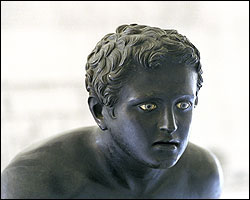
Bronze statue
A bronze statue of a runner, excavated from the Villa of the Papyri at Herculaneum.
(Photo by Mark Philbrick, Brigham Young University, courtesy Museo Archeologico Nazionale, Naples, Italy)

Been a while since I covered anything on television, but I caught Out of the Ashes: Recovering the Lost Library of Herculaneum on PBS this afternoon. Fascinating stuff.

Now mind you, I’m no scholar. I thought Herculaneum must be some type of glowing mineral that makes Hercules weak or something. Instead, it’s a city on the Bay of Naples that was covered up along with Pompeii when Mount Vesuvius erupted in 79 A.D.

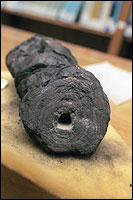
Along the shoreline of Herculaneum was a huge villa, and when it was partially excavated in 1752, 1,800 preserved papyrus scrolls were found. The show is about the attempts that have been made to unroll them. Sadly, many were destroyed before anyone started having real success. In fact, the first few that were found were burned as firewood, as their discoverers thought they were charcoal!

Rolled scroll
A carbonized scroll from Herculaneum; many scrolls were so badly burned and crushed that they have yet to be unrolled or read.
(Photo by Mark Philbrick, Brigham Young University, courtesy Biblioteca Nazionale, Naples, Italy)

You can catch the show on PBS, if you’re lucky, or buy it online.

The Washington Post ran an article on using imaging technology to read ancient scrolls (this isn’t specifically about the Herculaneum scrolls, but it’s the same technique being used).

Wired has a story about the scrolls and the group working to restore them: Tales from the Crypt: How a handful of Mormons with an infrared camera unlocked the secrets buried beneath Vesuvius.

And last, the Philodemus Project Home Page has some partial translations of the scrolls. (Philodemus being one of the philsophers who authored some of the scrolls that’ve been translated.)

Seriously…how cool is it that we can read the thoughts of these scribblers of 79 A.D.?